One week ago today was the start of Mumble's recent illness. He spent that day at daycare, and apparently spent much of the day just lying around and also threw up once while he was there. That night and into the next morning, he was vomiting almost constantly, not even holding down water, and we rushed to the vet on Tuesday.
Since then, he's been doing much better. The injections and medications the vet used to calm down his upset stomach and reduce the nausea really seemed to work well, as he was showing signs of improvement almost immediately. For several days following that, he was on a totally "bland" diet made up of cooked chicken and rice, which he ate in several small meals throughout the day instead of two regular sized meals. This meant he has been coming to work with me every day, so that I could monitor his health, give him all of his doses of medications, and feed him on his frequent-meal schedule. He, of course, has loved coming to the office and getting all of the attention from everyone here!
As of today, he's doing so much better I'm almost willing to say he's back to normal. "Almost" because he still has been having a little bit of digestive issues, although there has been absolutely no vomiting since we went to the vet last Tuesday. With Mumble, it is so hard to tell what is really going on with these types of things. Any change in his food whatsoever, even change to a "bland" diet, typically makes him a little bit sick because he has such a sensitive digestive system. So when he was getting better and better, but still having some diarrhea, it was hard to tell if that was still related to whatever was going on last week or if it is just because the chicken and rice is "different" than his normal diet.
I like to have answers. I tend to overthink things, read everything I can about any topic I need to know anything about, ask millions of questions whether in a meeting for a client or a doctor's appointment for myself, and try to decipher logical explanations for any and everything. There were no definite answers for why Mumble was sick (although I am grateful that there was a clear answer for what to do about it). The X-Rays taken by the vet showed a blurred appearance that she said was sometimes present as an indicator of pancreatitis. This seemed to have really surprised her though (indicating that other signs of such a serious condition weren't there?) because she said that she had them repeat the X-Ray just to be sure that he was actually lying perfectly still.
All of this lead to me going home and reading everything I could on canine pancreatitis. I tend to utilize a few different books whenever I have health-related questions about my pets. One is the Dog Owner's Home Veterinary Handbook, by Debra M. Eldredge DVM, the second is the Veterinarians' Guide to Your Dog Symptoms, by Michael S. Garvey DVM, and the third is the Natural Health Bible for Dogs and Cats, by Shawn Messonnier DVM, each of which I have on my Kindle. So I went home and consulted them to find out about this pancreatitis thing. What I read was pretty scary, but it seemed unlikely that this is what Mumble has. Although not uncommon, pancreatitis can apparently be life-threatening, and certainly some of the symptoms matched what Mumble was presenting with - vomiting up water, for example. It seemed like all of the descriptions I found, however, were of much more severe symptoms, like of dogs being so lethargic they were almost non-responsive, in so much abdominal pain that they wouldn't want to lie down, or showing signs of shock. So either Mumble only had a mild form of this, and I got him to the vet so quickly that these signs didn't show up yet, or it was not truly pancreatitis at all. Another thing that made me doubt that this could be what was wrong was that pancreatitis is most commonly seen in dogs that eat a lot of fatty foods or table scraps. Mumble is certainly not one of those dogs, given how limited his diet has to be because of all of his existing allergies and digestive issues. Also, pancreatitis is more common in middle-aged to older dogs, and according to some sources, more common in females. Again, all not characteristics of Mumble.
The vet determined that the best course of action was to immediately (and thoroughly) treat Mumble's symptoms, and that if he showed any signs of getting worse in the subsequent 48 hours or if he did not improve, then she would run some blood work to determine if indeed he had pancreatitis. Ultimately, we did not go that route because he was immediately so much better, so I guess we'll never know what the blood work would have shown, but the point was for him to get better, and he did.
What we did know is that Mumble did not have an obstruction in his bowels, he did not have bloat (thank God!), and he had not eaten anything poisonous. And what was suspected was that he did not have pancreatitis. That leaves more questions that answers, and not wanting him to go through this ever again, it leaves a huge "unknown" as to how to prevent it. I'm all about preventative treatment. Mumble is on every supplement and herbal remedy that has been suggested for him and eats organic dog food because these things are supposed to prevent his allergies from acting up, his joints from becoming arthritic, etc. So I want something we can do to stop this from happening too!
One thing that the vet mentioned is that all of this could have been related to his existing allergies. Mumble definitely suffers from seasonal allergies, and he is much more itchy, sneezy, runny, etc during this time of year. Generally, he goes through at least one time period in the spring or early summer where he just doesn't seem to feel 100% because of allergies.
Another thing that is possible is that his existing digestive issues flared up and caused this more extreme reaction. I've always suspected that Mumble could possibly have inflammatory bowel disease or irritable bowel syndrome. It doesn't seem like we need to put him through any tests or anything like that for this though, as all of the possibly-related issues are very well managed with a carefully planned diet and supplements. I've also always thought that he has excessive amounts of stomach acids. Whereas most dogs benefit from "fasting" when they have any kind of stomach illness, this has only ever made Mumble worse. If he has an empty stomach, he retches and vomits. I learned that early on with him, and in the countless times he's had an upset tummy, I never fast him like many people do with their dogs. I may reduce his food or give him rice or something else bland, but I know that an empty stomach will just make him worse.
You know how when you were a kid and you didn't feel well and your mom would say "if you'd just eat something, you'd feel better." And even if you felt like you'd throw up if you ate something, you'd trust her and eat a few crackers or some bread or something else really bland, and it WOULD make you feel a little better. Well, there's no way to reason with a dog in that way. No matter what I did, I couldn't get Mumble to eat that day when he was so sick. So my suspicion, not being a vet but just an overly-vigilant pet mom, is that Mumble was feeling ill because of allergies or because his tummy was just a little upset, and then he didn't want to eat because of that, and after skipping just a few meals, we found ourselves in the situation of him being really sick. It's like a bad cycle - he doesn't feel well, so he doesn't eat... he doesn't eat so he has an empty stomach and throws up... this makes him not feel well, so he continues to not eat.
Maybe this explains why the medicines worked so well. One was basically Pepcid, so it definitely would have reduced the stomach acids. Once those were in his system, he finally wanted to eat food and then he was on the way to recovery. I guess I'll never know for sure what caused all of this, but I'm grateful it didn't become anything more serious, and I'm beyond grateful for the thorough and expert care he got at Shane Veterinary Medical Center. And now if he ever DOES have pancreatitis, I guess I'll know what it looks like!

Showing posts with label health. Show all posts
Showing posts with label health. Show all posts
Monday, June 13, 2011

Friday, January 28, 2011
Free Pet Safety Pack
Here is a great freebie from the ASPCA - On their website, you can request a free Pet Safety Pack, which includes a window decal to alert rescue personnel that there are pets inside your home, and a magnet with information for pet poison control. In case of a fire or other emergency, you definitely want rescuers to know there are pets in need of rescue too!
Go to this link for the free decal: http://www.aspca.org/about-us/free-aspca-stuff/free-pet-safety-pack.aspx
Go to this link for the free decal: http://www.aspca.org/about-us/free-aspca-stuff/free-pet-safety-pack.aspx
Wednesday, October 20, 2010
Dog Safety and First Aid!
Pet safety is a topic every pet parent should be educated on. Dogs are pretty accident prone in general - eating things they shouldn't, getting injured in situations ranging from simple accidents while playing to trauma from car accidents, having things caught in their paw, mouth, eye, etc. Dogs (and cats) vomit, get diarrhea, cough or gag, limp, are lethargic, or experience a host of other symptoms from a variety of causes, and our pets can't explain to us how they feel or "where it hurts." If you google the terms "common pet emergencies" or "common pet injuries" you'll get a whole host of explanations for the types of things that can happen!
Here are a few examples of "emergencies" I've experienced with Mumble:
Laceration from moving his crate - When Mumble was 5 months old, on the day he had his neutering surgery, he had to be crated while I took a friend to the emergency room (it was not a good day all around for emergencies). Mumble decided he didn't want to be there in his crate that day, and experienced an "opposite reaction" to his sedative, basically meaning he had super-dog strength. From inside his crate, he moved it about 7-8 feet across the room by continuously throwing his body against the side of it. Problem? There was one of those water bottles attached to the side of the crate that has the little metal spout that the dogs drink from, and this basically gashed Mumble's back open. This didn't stop him from continuing to move the crate, so by the time I got home, the gash was pretty bad.
Eating plastic bags - Mumble went through a phase where he thought plastic bags were the most delicious things ever. I once came home and found part of one on the floor, and thought "at least he didn't eat all of it." Turned out, however, that he had actually gotten inside the kitchen cabinet (a high one) and climbed up it, and pulled all of the plastic bags out of the dispenser and eaten most of them.
Sudden limping - Mumble had an injury recently, and I had no idea when or how it occurred, but suddenly one morning we went out for our usual walk and he was limping.
Allergic reactions - Mumble's had allergic reactions to all kinds of things, resulting in sneezing and wheezing all night, foaming at the mouth, itching and scratching to the point of making the skin around his face bleed, and panting heavily. Mumble also once had an adverse reaction to vaccinations, which made him extremely sick and lethargic.
Car accident - Mumble was in the car with me when I had a car accident. Thankfully, he was not hurt, but it really made me realize how much I need to know what to do in an emergency if he is injured!
Each of these ended up in either a visit to the vet or an emergency phone call to the on-call vet for instructions. Thankfully, none of these incidents has ended up with serious injury or illness, and Mumble has come out ok every time. Still, accidents are not infrequent with pets, so we should all be prepared!
Enter the Pet Safety Seminar at Zoom Room Culver City. The Zoom Room had guest speaker Melanie Monteiro, author of "The Safe Dog Handbook," give a talk to a group of dog owners about pet safety tips, first aid, and emergency preparedness.
First off, I highly recommend Melanie's book. You can order it online at this link. I bought a copy at her talk that night, and I've already read it cover to cover. The book is so practical and user-friendly, it is definitely a must for the shelf of any pet parent. If you google Melanie, you will also not only find her website and more information about her, but also videos on youtube with tips and info about pet safety.
At the talk, Melanie gave us great insight into the importance of being prepared and of prevention. Prevention is the biggest key to pet safety! Even though we've all been told to "puppy-proof" our homes, Melanie explained that poisoning from substances like rat poison is still common!
Being prepared for an emergency includes simple things like having all of your pet's emergency contact numbers handy (the vet, the after-hours vet, the poison control hotline, etc) to having a well-stocked first aid and emergency kit. One of the most interesting things I learned is how to read your dog's vital signs - Melanie explained that it is important to know how to do this not only in response to a crisis but in order to be prepared for a crisis. You should know your dog's vital signs at their "normal" state so that you have something to compare to.
Melanie also demonstrated some pet first aid / emergency response skills. She showed us how to make a muzzle out of gauze, for situations when your pet needs to have medical attention and you want to prevent biting, which can be common in times of stress. She taught us which way to hold a dog that is injured if you have to carry it - with the wound towards your body, cradling the dog from underneath. She demonstrated (on a moving dog dummy) how to give a dog CPR, including the chess compressions and the respiration. For "mouth to mouth" on a pet, you do not breath into your dog's mouth, but into their nose! She showed us how to form a "seal" around the dog's (or cat's) nostrils in order to do CPR properly.
Melanie's book has a comprehensive list of all of the things that you should have in a pet first aid kit. There are also lots of resources online to help guide you. At a later date, I'll put together a list on this blog of all of the things that I have in my pet first aid kit, which I am working on putting together now!
I came away from the class with a lot of useful information, tips, and resources regarding pet safety, and definitely feel like I am now more prepared for emergency situations. I think this type of class is something every pet parent should take! There are lots of options you can find, from seminar-type classes, to intensive skill-based lessons.
Here is a list of resources for pet safety and first aid classes, and other related resources:
Melanie Monteiro's Pet Safety videos on YouTube: http://www.youtube.com/user/MelanieLMonteiro
The Safe Dog Handbook: http://www.thesafedoghandbook.com/index.html
Classes and First Aid Training by Melanie Monteiro: http://www.thesafedoghandbook.com/services.html
PetTech's PetSaver classes on pet first aid, CPR training, etc: http://www.pettech.net/programs.html
Dog First Aid book by the Red Cross: http://www.redcrossstore.org/Shopper/Product.aspx?UniqueItemId=95
Cat First Aid book by the Red Cross: http://www.redcrossstore.org/Shopper/Product.aspx?UniqueItemId=160&Page=1&StartAtPage=1&SId=201374&LocationId=0
PETCO's Pet First Aid online classes: http://www.petco.com/product/100690/PETCO-Online-Pet-First-Aid-Course.aspx
Online info from the American Veterinary Medical Association: First Aid Tips for Pet Parents: http://www.avma.org/firstaid/
Online info from the American Animal Hospital Association: Health Pets - Pet First Aid: http://www.healthypet.com/PetCare
About.com's article on First Aid for Pets: http://vetmedicine.about.com/cs/diseasesall/a/farnfirstaidtip.htm
First Aid Kits for Pets:
American Red Cross Deluxe Kit: http://www.entirelypets.com/petfirstaiddx.html
American Red Cross First Aid Pack: http://www.entirelypets.com/nepetfiaidki.html
Pet First Aid Kit: http://www.sitstay.com
Various kits by petfirstaid.org: http://www.petfirstaid.org/products.html
Here are a few examples of "emergencies" I've experienced with Mumble:
Laceration from moving his crate - When Mumble was 5 months old, on the day he had his neutering surgery, he had to be crated while I took a friend to the emergency room (it was not a good day all around for emergencies). Mumble decided he didn't want to be there in his crate that day, and experienced an "opposite reaction" to his sedative, basically meaning he had super-dog strength. From inside his crate, he moved it about 7-8 feet across the room by continuously throwing his body against the side of it. Problem? There was one of those water bottles attached to the side of the crate that has the little metal spout that the dogs drink from, and this basically gashed Mumble's back open. This didn't stop him from continuing to move the crate, so by the time I got home, the gash was pretty bad.
Eating plastic bags - Mumble went through a phase where he thought plastic bags were the most delicious things ever. I once came home and found part of one on the floor, and thought "at least he didn't eat all of it." Turned out, however, that he had actually gotten inside the kitchen cabinet (a high one) and climbed up it, and pulled all of the plastic bags out of the dispenser and eaten most of them.
Sudden limping - Mumble had an injury recently, and I had no idea when or how it occurred, but suddenly one morning we went out for our usual walk and he was limping.
Allergic reactions - Mumble's had allergic reactions to all kinds of things, resulting in sneezing and wheezing all night, foaming at the mouth, itching and scratching to the point of making the skin around his face bleed, and panting heavily. Mumble also once had an adverse reaction to vaccinations, which made him extremely sick and lethargic.
Car accident - Mumble was in the car with me when I had a car accident. Thankfully, he was not hurt, but it really made me realize how much I need to know what to do in an emergency if he is injured!
Each of these ended up in either a visit to the vet or an emergency phone call to the on-call vet for instructions. Thankfully, none of these incidents has ended up with serious injury or illness, and Mumble has come out ok every time. Still, accidents are not infrequent with pets, so we should all be prepared!
Enter the Pet Safety Seminar at Zoom Room Culver City. The Zoom Room had guest speaker Melanie Monteiro, author of "The Safe Dog Handbook," give a talk to a group of dog owners about pet safety tips, first aid, and emergency preparedness.
First off, I highly recommend Melanie's book. You can order it online at this link. I bought a copy at her talk that night, and I've already read it cover to cover. The book is so practical and user-friendly, it is definitely a must for the shelf of any pet parent. If you google Melanie, you will also not only find her website and more information about her, but also videos on youtube with tips and info about pet safety.
At the talk, Melanie gave us great insight into the importance of being prepared and of prevention. Prevention is the biggest key to pet safety! Even though we've all been told to "puppy-proof" our homes, Melanie explained that poisoning from substances like rat poison is still common!
Being prepared for an emergency includes simple things like having all of your pet's emergency contact numbers handy (the vet, the after-hours vet, the poison control hotline, etc) to having a well-stocked first aid and emergency kit. One of the most interesting things I learned is how to read your dog's vital signs - Melanie explained that it is important to know how to do this not only in response to a crisis but in order to be prepared for a crisis. You should know your dog's vital signs at their "normal" state so that you have something to compare to.
Melanie also demonstrated some pet first aid / emergency response skills. She showed us how to make a muzzle out of gauze, for situations when your pet needs to have medical attention and you want to prevent biting, which can be common in times of stress. She taught us which way to hold a dog that is injured if you have to carry it - with the wound towards your body, cradling the dog from underneath. She demonstrated (on a moving dog dummy) how to give a dog CPR, including the chess compressions and the respiration. For "mouth to mouth" on a pet, you do not breath into your dog's mouth, but into their nose! She showed us how to form a "seal" around the dog's (or cat's) nostrils in order to do CPR properly.
Melanie's book has a comprehensive list of all of the things that you should have in a pet first aid kit. There are also lots of resources online to help guide you. At a later date, I'll put together a list on this blog of all of the things that I have in my pet first aid kit, which I am working on putting together now!
I came away from the class with a lot of useful information, tips, and resources regarding pet safety, and definitely feel like I am now more prepared for emergency situations. I think this type of class is something every pet parent should take! There are lots of options you can find, from seminar-type classes, to intensive skill-based lessons.
Here is a list of resources for pet safety and first aid classes, and other related resources:
Melanie Monteiro's Pet Safety videos on YouTube: http://www.youtube.com/user/MelanieLMonteiro
The Safe Dog Handbook: http://www.thesafedoghandbook.com/index.html
Classes and First Aid Training by Melanie Monteiro: http://www.thesafedoghandbook.com/services.html
PetTech's PetSaver classes on pet first aid, CPR training, etc: http://www.pettech.net/programs.html
Dog First Aid book by the Red Cross: http://www.redcrossstore.org/Shopper/Product.aspx?UniqueItemId=95
Cat First Aid book by the Red Cross: http://www.redcrossstore.org/Shopper/Product.aspx?UniqueItemId=160&Page=1&StartAtPage=1&SId=201374&LocationId=0
PETCO's Pet First Aid online classes: http://www.petco.com/product/100690/PETCO-Online-Pet-First-Aid-Course.aspx
Online info from the American Veterinary Medical Association: First Aid Tips for Pet Parents: http://www.avma.org/firstaid/
Online info from the American Animal Hospital Association: Health Pets - Pet First Aid: http://www.healthypet.com/PetCare
About.com's article on First Aid for Pets: http://vetmedicine.about.com/cs/diseasesall/a/farnfirstaidtip.htm
First Aid Kits for Pets:
American Red Cross Deluxe Kit: http://www.entirelypets.com/petfirstaiddx.html
American Red Cross First Aid Pack: http://www.entirelypets.com/nepetfiaidki.html
Pet First Aid Kit: http://www.sitstay.com
Various kits by petfirstaid.org: http://www.petfirstaid.org/products.html
Tuesday, October 19, 2010
Blue Buffalo Dog Food Recall
While I was out of town last week, and Mumble was being boarded, I had a bit of a scare about his dry food because I heard the news of a recall of Blue Buffalo brand dog food. Mumble eats the Blue Buffalo Adult Chicken dry food mixed in with his wet food every day. This was one of the "flavors" on the recall list, and since I had left his food with the boarding facility in small baggies, pre-portioned for each meal, rather than the entire bag of food, there was no way for anyone to check to see if the food was one of the specific "batches" recalled! I had to have the boarding people just stop giving him the dry food altogether, just in case. Thankfully, they were able to make up the difference in his meals by supplementing his wet food with a little bit of cooked chicken and rice (which I'm sure he thought was much better anyway).
When I got back home I was able to check the bag, and thankfully it wasn't on the recall list anyway! So I don't have to worry about Mumble getting sick from the amount that he ate out of that bag before I heard about the recall.
Blue Buffalo was able to pinpoint exactly which batches of food had been affected, and even ascertained exactly how it happened. You can read the press release on their website here. If you feed your dog one of the "flavors" on the list, the way you determine if your dog food is affected is by looking at the expiration date. Here is the list from the Blue Buffalo website:
The recall is due to the discovery by the company of the presence of vitamin D in the product at levels "higher than specifications." According to the Blue Buffalo website, and other information available on the web related to this recall, excessive amounts of vitamin D can be harmful to pets. The FDA indicates that 36 cases have been reported nationwide of illness related to the excessive amounts of vitamin D in the recalled food (read here for more from the FDA on this recall). Blue Buffalo's website states that it will reimburse veterinary bills associated with illness as a result of the recalled food.
I was personally very curious about this vitamin D issue. Mumble eats a pretty healthy diet - his wet food is organic, and he has various supplements added to each meal. I've been reading a lot about supplements and "natural health" for pets lately, due to the high levels of supplements Mumble has to be on. So I was really curious about how a vitamin that you would believe to be beneficial, or at least not harmful, could cause so much concern. What I read was really interesting. According to many articles, etc, including the "Natural Health Bible for Dogs and Cats" by Shawn Messioner (I love this book!), the most common cause of vitamin D toxicity is from a dog ingesting rat poison! Of course, we all know that rat poison is one of the most common causes of poisoning to pets, but I never thought about it being linked to something as benign sounding as vitamin D.
There is an interesting article I found online on this subject, written by a veterinarian. You can read it at this link. According to Dr. Huston, vitamin D toxicity causes hypercalcemia, a condition that causes a whole gambit of problems and affects the dog's internal organs. The list of possible symptoms of vitamin D toxicity in her website is much more extensive, but with some consistency, than the list on the recall information websites. (*You can also read about vitamin toxicities at the PetPlace website).
The most alarming information I found, at least as it directly relates to Mumble, is the link between fish oil supplements and vitamin D toxicity. Apparently, fish oil supplements are known to be a good source of vitamin D, but it is possible for a pet parent to "overdose" their pet by providing too much of the supplement and causing vitamin D toxicity to occur. Mumble is on a fish oil with probiotics supplement, which, after much trial and error with various other probiotics, etc, was the best thing for him in terms of helping with all of his digestive issues. The fish oil also has a positive impact on his skin allergies. So the information about fish oil and vitamin D was definitely a reminder to me about how important it is to be extra careful with giving him the right amounts. It also made me very grateful for our vet, Dr. Shane, who is excellent at natural remedies and holistic approaches to health, and carefully helps me to monitor all of Mumble's supplements and dietary needs.
When I got back home I was able to check the bag, and thankfully it wasn't on the recall list anyway! So I don't have to worry about Mumble getting sick from the amount that he ate out of that bag before I heard about the recall.
Blue Buffalo was able to pinpoint exactly which batches of food had been affected, and even ascertained exactly how it happened. You can read the press release on their website here. If you feed your dog one of the "flavors" on the list, the way you determine if your dog food is affected is by looking at the expiration date. Here is the list from the Blue Buffalo website:
| Product | Bag Size | Best Used By Dates |
| BLUE Wilderness Chicken (Dog) | 4.5 lb., 11 lb., 24lb. | JUL1211B, JUL1311B, JUL2611Z, JUL2711Z, JUL2811Z |
| BLUE Basics Salmon (Dog) | 11 lb., 24 lb. | AUG2111B, AUG2211B |
| BLUE Large Breed Adult Chicken | 30 lb. | SEP 22 11 P, SEP 23 11 P, OCT 26 11 P |
The recall is due to the discovery by the company of the presence of vitamin D in the product at levels "higher than specifications." According to the Blue Buffalo website, and other information available on the web related to this recall, excessive amounts of vitamin D can be harmful to pets. The FDA indicates that 36 cases have been reported nationwide of illness related to the excessive amounts of vitamin D in the recalled food (read here for more from the FDA on this recall). Blue Buffalo's website states that it will reimburse veterinary bills associated with illness as a result of the recalled food.
I was personally very curious about this vitamin D issue. Mumble eats a pretty healthy diet - his wet food is organic, and he has various supplements added to each meal. I've been reading a lot about supplements and "natural health" for pets lately, due to the high levels of supplements Mumble has to be on. So I was really curious about how a vitamin that you would believe to be beneficial, or at least not harmful, could cause so much concern. What I read was really interesting. According to many articles, etc, including the "Natural Health Bible for Dogs and Cats" by Shawn Messioner (I love this book!), the most common cause of vitamin D toxicity is from a dog ingesting rat poison! Of course, we all know that rat poison is one of the most common causes of poisoning to pets, but I never thought about it being linked to something as benign sounding as vitamin D.
There is an interesting article I found online on this subject, written by a veterinarian. You can read it at this link. According to Dr. Huston, vitamin D toxicity causes hypercalcemia, a condition that causes a whole gambit of problems and affects the dog's internal organs. The list of possible symptoms of vitamin D toxicity in her website is much more extensive, but with some consistency, than the list on the recall information websites. (*You can also read about vitamin toxicities at the PetPlace website).
The most alarming information I found, at least as it directly relates to Mumble, is the link between fish oil supplements and vitamin D toxicity. Apparently, fish oil supplements are known to be a good source of vitamin D, but it is possible for a pet parent to "overdose" their pet by providing too much of the supplement and causing vitamin D toxicity to occur. Mumble is on a fish oil with probiotics supplement, which, after much trial and error with various other probiotics, etc, was the best thing for him in terms of helping with all of his digestive issues. The fish oil also has a positive impact on his skin allergies. So the information about fish oil and vitamin D was definitely a reminder to me about how important it is to be extra careful with giving him the right amounts. It also made me very grateful for our vet, Dr. Shane, who is excellent at natural remedies and holistic approaches to health, and carefully helps me to monitor all of Mumble's supplements and dietary needs.
Friday, October 8, 2010
Mumble, at age 2

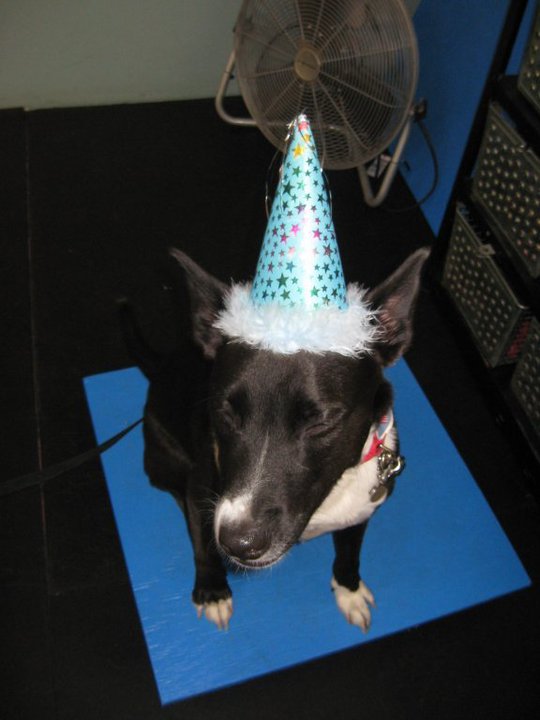
Mumble recently had his second birthday, and we had a birthday party at the Zoom Room in Culver City with a few of his dog friends. He jointly celebrated the day with Kihei, who turned 1 two days before Mumble's birthday. The party was lots of fun for the dogs and the people. We had food, favors, and of course birthday cake (both for people and dogs to eat).
Mumble has been through a lot of changes recently. Several months ago, his regular dog walker moved away and we started the lengthy process of searching for a good replacement. Mumble's new dog walker has not been with him very long now, and although I think in general it's working out, she's had her hands full with him as they both adjust to each other. Some days, inexplicably, he simply refuses to go on a walk with her for more than a few yards away from the entrance to my apartment building! He's such a stubborn, independent dog!
Additionally, Mumble had a sprained leg, which resulted in being on "house arrest" for a few months, with no daycare and no agility. He has recently been given the "all clear" to return to both of those activities, but we are supposed to be "slowly working up to full activity levels," meaning that at this point, he can only go to daycare for a few hours at a time.
I don't know if it was the change in his exercise levels, his "depressed" state when he no longer got to go to daycare, all the training we've been doing, or simple maturity, but definitely there have been some changes in Mumble's personality at age 2. He's generally a little less crazy / hyper and a little calmer, although still far from being what you would call a "calm dog" overall.
Health-wise, we are still on the ever-changing quest for the right balance of food, supplements, and medications to keep him healthy with all of his allergies and digestive difficulties. Certainly we have learned a lot, and all of those issues are much more under control than they were when he was still a puppy. It is such a relief to have less frequent allergy attacks, significantly less frequent bouts of diarrhea, and a quicker response to treatment when either of those things still happen!
Overall, I can (a bit sadly) report that Mumble is definitely more and more of a grown up dog and no longer a puppy!
Friday, August 20, 2010
House Arrest Continued, another appointment with the Vet, and a difficult week overall
Mumble has now been on his "limited activity" restrictions for healing of his shoulder & elbow sprain for two weeks (today is Day 15 to be exact), and we've now gone back for our check up with Dr. Shane.
First, I have to start by acknowledging the emotional difficulty of this particular week. It was two years ago this week that I lost Padfoot, and while that is emotionally heart-wrenching for me in general, the stress of thinking about Mumble having any health problems that could be serious on this particular week was not easy for me to deal with. Not a day goes by that I don't miss Padfoot, as much as I love Mumble and am grateful to have him in my life. The thought that I could ever prematurely lose him as well is terrifying, even if that fear is not totally based in rational thought. So I didn't love the fact that we had a vet appointment scheduled for this particular week, and sat in the vet's office today petrified of what she could possibly come back and tell me.
In general, this week was a little easier than last week, however, in terms of Mumble's healing process. The positive impact of having the walk at the beach with Chopper and Mandy over the weekend appeared to have some lasting affects, so while I still had concerns about his loss of appetite and he still had times where he resisted going for a walk, in general I saw an improvement in his overall demeanor. The instances of visible "limping" were extremely rare, so he seemed to also be improving greatly in terms of his physical injury.
I was hopeful going into the appointment with Dr. Shane that Mumble would be given the "all clear" to return back to normal, but such was not the case. Although with the medications, he is improving and his pain is managed, the orthopedic exam still showed signs of tension in the shoulder and elbow, evidencing the sprain/injured joints.
Dr. Shane therefore continued to advise limited activity levels, although modified to start to allow for some increases in a careful, planned manner. Walks are still OK. Additionally, he is permitted to go back to doing some agility activities, although without the A-Frame, the weave poles, or any "sharp turns." Which leaves (I guess) low level jumps, the dog walk, and the table? It's not much but at least he'll have something! We can do this no more than one time per week. As to daycare, a full day would still be too much for him, as would multiple daycare visits per week. Thus, she said he was allowed to do "half-days" a couple of times per week. I don't exactly know how that will work out with my work schedule, but I guess we'll figure something out.
As to medications, Dr. Shane believes Mumble will need to be on the Glucosamine supplements for the rest of his life. I've actually done a lot of research / reading on these supplements, and I believe that this will have a positive impact on his health and well-being going forward, so I am OK with this being a permanent addition to his health supplements. He will no longer take the Traumeel (the homeopathic anti-inflammatory) on a regular basis. Instead, he will only take it "as needed" if he shows any limping or signs of pain without it.
The prognosis? The vet still believes Mumble will ultimately heal and be back to normal, but she wants to reevaluate him in one month. This type of injury, she explained, could lead to the onset of arthritis in those joints if not treated. Thus, if he is still not healed after another 4 weeks, she will do X-Rays and we will decide whether or not surgery is the appropriate treatment option. She stressed that for a very active dog like Mumble, surgery could be the most appropriate thing if he is not healing so that he is not limited by arthritis and joint issues on a long term basis.
Overall, it was overwhelming, but I still feel like we are on the right path and doing the right things, and that ultimately Mumble will get better, hopefully without surgery. I'm thankful that this issue is something we can treat and deal with, and not something potentially life-threatening. I am also thankful for everyone's well-wishes, support, etc during the past few weeks about this!
First, I have to start by acknowledging the emotional difficulty of this particular week. It was two years ago this week that I lost Padfoot, and while that is emotionally heart-wrenching for me in general, the stress of thinking about Mumble having any health problems that could be serious on this particular week was not easy for me to deal with. Not a day goes by that I don't miss Padfoot, as much as I love Mumble and am grateful to have him in my life. The thought that I could ever prematurely lose him as well is terrifying, even if that fear is not totally based in rational thought. So I didn't love the fact that we had a vet appointment scheduled for this particular week, and sat in the vet's office today petrified of what she could possibly come back and tell me.
In general, this week was a little easier than last week, however, in terms of Mumble's healing process. The positive impact of having the walk at the beach with Chopper and Mandy over the weekend appeared to have some lasting affects, so while I still had concerns about his loss of appetite and he still had times where he resisted going for a walk, in general I saw an improvement in his overall demeanor. The instances of visible "limping" were extremely rare, so he seemed to also be improving greatly in terms of his physical injury.
I was hopeful going into the appointment with Dr. Shane that Mumble would be given the "all clear" to return back to normal, but such was not the case. Although with the medications, he is improving and his pain is managed, the orthopedic exam still showed signs of tension in the shoulder and elbow, evidencing the sprain/injured joints.
Dr. Shane therefore continued to advise limited activity levels, although modified to start to allow for some increases in a careful, planned manner. Walks are still OK. Additionally, he is permitted to go back to doing some agility activities, although without the A-Frame, the weave poles, or any "sharp turns." Which leaves (I guess) low level jumps, the dog walk, and the table? It's not much but at least he'll have something! We can do this no more than one time per week. As to daycare, a full day would still be too much for him, as would multiple daycare visits per week. Thus, she said he was allowed to do "half-days" a couple of times per week. I don't exactly know how that will work out with my work schedule, but I guess we'll figure something out.
As to medications, Dr. Shane believes Mumble will need to be on the Glucosamine supplements for the rest of his life. I've actually done a lot of research / reading on these supplements, and I believe that this will have a positive impact on his health and well-being going forward, so I am OK with this being a permanent addition to his health supplements. He will no longer take the Traumeel (the homeopathic anti-inflammatory) on a regular basis. Instead, he will only take it "as needed" if he shows any limping or signs of pain without it.
The prognosis? The vet still believes Mumble will ultimately heal and be back to normal, but she wants to reevaluate him in one month. This type of injury, she explained, could lead to the onset of arthritis in those joints if not treated. Thus, if he is still not healed after another 4 weeks, she will do X-Rays and we will decide whether or not surgery is the appropriate treatment option. She stressed that for a very active dog like Mumble, surgery could be the most appropriate thing if he is not healing so that he is not limited by arthritis and joint issues on a long term basis.
Overall, it was overwhelming, but I still feel like we are on the right path and doing the right things, and that ultimately Mumble will get better, hopefully without surgery. I'm thankful that this issue is something we can treat and deal with, and not something potentially life-threatening. I am also thankful for everyone's well-wishes, support, etc during the past few weeks about this!
Friday, August 13, 2010
House Arrest Days 7-9
Today is Day 9 of Mumble's limited activity restrictions, to promote healing of his leg sprain. Only one week to go until we go back to the vet to check on how things are going!
On Day 7 (Wednesday), Mumble came to work with me during the day, and seemed to enjoy that. He loves seeing all of the people in my office and playing with his toys here. He was not too active during the day, but he was a little bit demanding (for attention). When he was bored, he'd sit by my chair and very softly bark at me. He got to rotate between my office and Mandy's office though so that kept him entertained. He seemed to be at his most "normal" on that day, so far.
Wednesday night, we had our last Therapy Dog class for this session at the Zoom Room. Mumble had an overflow of energy and excitement going in, and then there were some "extras" that night, including an additional dog doing a makeup class, and the trainer's two kids. Mumble was pretty obsessive with wanting to play with or bark at the new dog, and wanting to run around with the new kids, so he did not do as well on some of the "items" as he normally does. During the loose leash walking item, where they are supposed to be able to pass other dogs and distractions, Mumble was pulling on the leash and just generally acting hyped up. After a while though, he did seem to settle down and get into the routine of class. We'll definitely be taking another session of Therapy Dog to continue to hone and perfect his skills!
Thursday was a difficult day. I did not want to write about this when it was happening until I got home and was able to see Mumble for myself and check on him. The day started with Mumble having some sneezy / scratchy allergies in the morning, and just generally being a little more tired than usual. He did have plenty of energy to be "naughty" on our walk though! We walked to Coffee Bean on our morning walk, and after I got my coffee and came back outside, Mumble got away from me when I was untying his leash and just ran around all of the table trying to get people to pet him or give him food. The rest of the walk was pretty uneventful.
Thursday afternoon, I got a call from Mumble's dog walker, which sent me into a slight panic. Even though she said Mumble didn't appear to be in distress, when the words "he doesn't seem to want to get up and walk" came out of her mouth, all of the memories about losing Padfoot came rushing to me, and I had to force myself to remain calm. This is Mumble, not Padfoot. He has an injury, and is not feeling well, but he is not dying. OK, so then I asked her a bunch of questions, and ascertained that Mumble was not wanting to go for a walk, and when she finally got him to go out, just spent the whole time trying to turn around and go back home. When she brought him back in, he went straight back to bed and refused to do anything else. For a dog that is usually extremely hyper and active, this was definitely not normal, and caused her concern. However, his breathing was normal, he didn't seem to be in distress or even in pain.
I contacted Mumble's vet's office and talked to one of the vets there a little while later. After listening to my description of the details from the dog walker, she did not think that being lethargic as a reaction to the medications was the issue. Her opinion? Mumble is "sad" or "depressed" because of the drastic change in his lifestyle over the past week. She said it wasn't uncommon for "working dogs" to become depressed after they were injured or something because when their normal activities were taken away they became frustrated and sad. Poor Mumble, but at least she doesn't think it is something to cause serious concern. Because I google everything, I found this article about dog depression online, and it really does seem to make sense that this could be what is happening to Mumble.
I cheered Mumble up that evening with a visit to Mandy and Chopper, his favorite human and favorite dog pal. On his walk with Chopper, Mumble showed absolutely no signs of not wanting to walk, being tired, or wanting to turn back, which I guess would seem to support the depression theory rather than that something else is physically wrong.
This morning (Day 9), Mumble's lethargy and resistance to his walk continued with me. He was at first just appearing to be tired and not wanting to get up. When we went out for our walk, he was doing fine for the first block. Then out of nowhere, he turned around and tried to head back towards home. I guess this is what he was doing to the dog walker? His tail was between his leg, and he had a slightly panicked look. It is the way he acts when he is scared of something (usually nothing, or something irrational). From that point forward, he did not want to be walking, he just wanted to go back home. I tried giving him commands to walk nicely, to look at me, etc. I tried giving him treats (he clamped his stubborn jaws shut at that), and encouraging him to keep going. It didn't matter. Nothing changed the fact that he just wanted to go back home. When we made it back, he went straight to his favorite spot in the living room (the cushy armchair) and laid down. But back in the house, he was willing to take treats and come on command, etc, and did seem much more relaxed.
The other thing worrying is the loss of appetite. For the past few days, he eats hardly any breakfast and usually has to be coaxed to eat all of his dinner. He has several medications and supplements, some of which he takes with his food, and I don't know if he doesn't like the taste of all of that or what. The vet does think that one of the supplements could cause a loss of appetite, so maybe that's it. Although I guess if he is really depressed, he wouldn't want to eat, right?
In terms of the physical injury, he does seem to be healing well. But I don't know how we are going to make it through the next few weeks if we keep having to "rest" and not go to daycare and agility. I just keep thinking of all of those "depression is real" commercials on TV where someone talks about not wanting to get out of bed or eat, and I think - oh geez, now that's my dog!
On Day 7 (Wednesday), Mumble came to work with me during the day, and seemed to enjoy that. He loves seeing all of the people in my office and playing with his toys here. He was not too active during the day, but he was a little bit demanding (for attention). When he was bored, he'd sit by my chair and very softly bark at me. He got to rotate between my office and Mandy's office though so that kept him entertained. He seemed to be at his most "normal" on that day, so far.
Wednesday night, we had our last Therapy Dog class for this session at the Zoom Room. Mumble had an overflow of energy and excitement going in, and then there were some "extras" that night, including an additional dog doing a makeup class, and the trainer's two kids. Mumble was pretty obsessive with wanting to play with or bark at the new dog, and wanting to run around with the new kids, so he did not do as well on some of the "items" as he normally does. During the loose leash walking item, where they are supposed to be able to pass other dogs and distractions, Mumble was pulling on the leash and just generally acting hyped up. After a while though, he did seem to settle down and get into the routine of class. We'll definitely be taking another session of Therapy Dog to continue to hone and perfect his skills!
Thursday was a difficult day. I did not want to write about this when it was happening until I got home and was able to see Mumble for myself and check on him. The day started with Mumble having some sneezy / scratchy allergies in the morning, and just generally being a little more tired than usual. He did have plenty of energy to be "naughty" on our walk though! We walked to Coffee Bean on our morning walk, and after I got my coffee and came back outside, Mumble got away from me when I was untying his leash and just ran around all of the table trying to get people to pet him or give him food. The rest of the walk was pretty uneventful.
Thursday afternoon, I got a call from Mumble's dog walker, which sent me into a slight panic. Even though she said Mumble didn't appear to be in distress, when the words "he doesn't seem to want to get up and walk" came out of her mouth, all of the memories about losing Padfoot came rushing to me, and I had to force myself to remain calm. This is Mumble, not Padfoot. He has an injury, and is not feeling well, but he is not dying. OK, so then I asked her a bunch of questions, and ascertained that Mumble was not wanting to go for a walk, and when she finally got him to go out, just spent the whole time trying to turn around and go back home. When she brought him back in, he went straight back to bed and refused to do anything else. For a dog that is usually extremely hyper and active, this was definitely not normal, and caused her concern. However, his breathing was normal, he didn't seem to be in distress or even in pain.
I contacted Mumble's vet's office and talked to one of the vets there a little while later. After listening to my description of the details from the dog walker, she did not think that being lethargic as a reaction to the medications was the issue. Her opinion? Mumble is "sad" or "depressed" because of the drastic change in his lifestyle over the past week. She said it wasn't uncommon for "working dogs" to become depressed after they were injured or something because when their normal activities were taken away they became frustrated and sad. Poor Mumble, but at least she doesn't think it is something to cause serious concern. Because I google everything, I found this article about dog depression online, and it really does seem to make sense that this could be what is happening to Mumble.
I cheered Mumble up that evening with a visit to Mandy and Chopper, his favorite human and favorite dog pal. On his walk with Chopper, Mumble showed absolutely no signs of not wanting to walk, being tired, or wanting to turn back, which I guess would seem to support the depression theory rather than that something else is physically wrong.
This morning (Day 9), Mumble's lethargy and resistance to his walk continued with me. He was at first just appearing to be tired and not wanting to get up. When we went out for our walk, he was doing fine for the first block. Then out of nowhere, he turned around and tried to head back towards home. I guess this is what he was doing to the dog walker? His tail was between his leg, and he had a slightly panicked look. It is the way he acts when he is scared of something (usually nothing, or something irrational). From that point forward, he did not want to be walking, he just wanted to go back home. I tried giving him commands to walk nicely, to look at me, etc. I tried giving him treats (he clamped his stubborn jaws shut at that), and encouraging him to keep going. It didn't matter. Nothing changed the fact that he just wanted to go back home. When we made it back, he went straight to his favorite spot in the living room (the cushy armchair) and laid down. But back in the house, he was willing to take treats and come on command, etc, and did seem much more relaxed.
The other thing worrying is the loss of appetite. For the past few days, he eats hardly any breakfast and usually has to be coaxed to eat all of his dinner. He has several medications and supplements, some of which he takes with his food, and I don't know if he doesn't like the taste of all of that or what. The vet does think that one of the supplements could cause a loss of appetite, so maybe that's it. Although I guess if he is really depressed, he wouldn't want to eat, right?
In terms of the physical injury, he does seem to be healing well. But I don't know how we are going to make it through the next few weeks if we keep having to "rest" and not go to daycare and agility. I just keep thinking of all of those "depression is real" commercials on TV where someone talks about not wanting to get out of bed or eat, and I think - oh geez, now that's my dog!
Thursday, August 12, 2010
Vaccination Clinic this weekend in West LA/Beverly Hills and Silverlake
The Urban Pet Los Angeles, a boutique retail pet food and supplies store on Beverly Blvd (and also in Silver Lake) is having a vaccination clinic this weekend. I thought I'd pass the info along in case any of you other pet parents are in need of updated shots at affordable prices. Here is what their flier (sent via email) says:
VACCINATION CLINIC
Saturday, August 14
Beverly 10am-12pm
(323.933.2100)
Silver Lake 1:30-3:00pm
(323.664.4700)
CASH ONLY
CANINE
DHPP-C (core vaccination for puppies) - $35
Bordetella (kennel cough vaccination) - $20
Rabies (required by law - 3* year booster) - $20
Rattlesnake (for dogs that go hiking - 6 month booster) - $25
FELINE
FVRCP (core vaccination for all cats - 3* year booster) - $30
Feline Rabies (required by law in certain cities) - $20
FELV (for cats that go outside - may require testing prior to administration) - $25
*3 year durations are dependent on vaccination history.
CATS & DOGS
Health Certificate (for interstate travel) - $35
Health Certificate (for internationaltravel) - $50
Microchip (inc. registration - good for domestic/international use) - $50
Complete de-worming for cats or dogs - priced by weight
We recommend de-worming treatment yearly to protect you and your family from potentially harmful parasites
The email also says that you can call or email (info@theurbanpet.net) for a reserved spot, although walk-ins are stated to be welcome too!
Tuesday, August 10, 2010
House Arrest Day 6
Today is Day 6 of Mumble's "limited physical activity" sentence for the healing of his sprained leg/shoulder. Things are reasonably going well so far, but I definitely notice a difference already in his behavior.
First off, and on a positive note, in regards to his injury itself, I am really amazed at this medication the vet has put him on, because it seemed to help with the pain right away. And presumably it is helping with the inflammation too, so he is definitely showing signs of limping and stiffness less often. The medication is called Traumeel, and it is a natural, herbal anti-inflammatory and analgesic that is actually made for humans but can be used on dogs. Natural / herbal pain relief is probably better for Mumble, who has previously had an adverse reaction to either pain medication or sedatives. Given that Mumble now takes so many pills and supplements I had to create a chart to make sure I gave him everything at the right time, I decided I should become more educated about what I am putting into his body and did some online research. Traumeel is something that is apparently frequently prescribed to people for their sport related injuries, sprains, and recovery from surgery. It is a homeopathic blend with a lot of different active ingredients that stimulate the "healing of wounds, fractures and dislocation," act as an analgesic, and prevent inflammation and infection. What's great about it is that it can be given to dogs without the extensive bloodwork that may be required for ongoing use of more traditional pain medications. What I know is that Mumble seemed to react positively right away. Remarkably, as soon as his next walk after his first dose, he was already showing signs of improvement. So he'll continue taking his two pills twice a day, hidden in whatever I can convince him to eat at that moment, until the vet tells us otherwise.
In terms of Mumble's reaction to the limitation on his physical activities, I think overall he is doing well, but there is definitely a difference. This will be the first week since Mumble was 5 months old that he didn't go to daycare for at least a couple of days. Well, that's not totally true, he didn't go to daycare when we were in Georgia for Christmas, but that week he had my sister's dogs, Penny and Dexter, who are just as hyper as him, to play with every day all day, so that doesn't really count. Usually, he gets to spend at least a few days at The Loved Dog running around with 30-40 other dogs all day, herding them, and acting like he is the king of the place. So it's a big difference to go from that to being at home with no dogs to play with, only Rascal to herd around, and no one to be the king of (there is no way Rascal is letting Mumble be in charge of anything!).
So while I have not seen any "bad behaviors" (I don't want to dare to say "yet"), he is showing signs that he's a little bored. Last night (Day 5) when I came home from work, he greeted me as usual, and we went on a normal walk. His normal evening activity level is pretty mellow when we are just at home. He may play a little, we may practice some of his tricks or other stuff, and he might even chase around a treat toy, but he's pretty content to lounge around on the couch for a majority of the evening and have his belly rubbed. Last night, he was much more active. He started pulling apart stuffed toys, strewing stuffing around the room, chased Rascal back and forth to the bedroom and living room (until Rascal was tired of that game and with one scathing look, stopped Mumble in his tracks, and then retired to the back of the couch), etc. The worst though was that he was generally trying to demand constant attention. He attempted to destroy a treat toy because it was empty, and kept sitting right next to wherever I was and barking at me ever so quietly to get me to play with him. Maybe this is normal? I don't know; I've always been a believer in "a tired dog is a good dog," so Mumble stays pretty active and entertained so that he doesn't have to engage in inappropriate behaviors to gain my attention for an activity.
The sad thing was that as much attention as I could give him, I couldn't give him what he wanted, which was a lot of physical activity. He was whining at me because he wanted me to play rough with him on the floor, or throw a ball for him to run after, or take him outside to play with the dog from upstairs when it went by. My "attention" of petting him, and trying to get him to do low-impact things like trick or behavior skills would only placate him for a little bit, and then he'd be begging all over again.
We'll see how he is behaving tonight (Day 6) after yet another day at home. We had a great walk this morning - long, but not at a fast pace, and with plenty of "training" along the way. He is mastering the automatic stop and sit at the curb before we cross the street, so if he takes a new skill out of all of this, I guess that's a good thing too. Tomorrow, he'll most likely be coming to the office with me during the day, and then we'll still be going to our "Therapy Dog" class tomorrow night (it's the last class, and the vet approved his participation in this - but not in agility). 10 days to go until we go back to the vet for a check up to see if he is healed, or if the sentence continues!
First off, and on a positive note, in regards to his injury itself, I am really amazed at this medication the vet has put him on, because it seemed to help with the pain right away. And presumably it is helping with the inflammation too, so he is definitely showing signs of limping and stiffness less often. The medication is called Traumeel, and it is a natural, herbal anti-inflammatory and analgesic that is actually made for humans but can be used on dogs. Natural / herbal pain relief is probably better for Mumble, who has previously had an adverse reaction to either pain medication or sedatives. Given that Mumble now takes so many pills and supplements I had to create a chart to make sure I gave him everything at the right time, I decided I should become more educated about what I am putting into his body and did some online research. Traumeel is something that is apparently frequently prescribed to people for their sport related injuries, sprains, and recovery from surgery. It is a homeopathic blend with a lot of different active ingredients that stimulate the "healing of wounds, fractures and dislocation," act as an analgesic, and prevent inflammation and infection. What's great about it is that it can be given to dogs without the extensive bloodwork that may be required for ongoing use of more traditional pain medications. What I know is that Mumble seemed to react positively right away. Remarkably, as soon as his next walk after his first dose, he was already showing signs of improvement. So he'll continue taking his two pills twice a day, hidden in whatever I can convince him to eat at that moment, until the vet tells us otherwise.
In terms of Mumble's reaction to the limitation on his physical activities, I think overall he is doing well, but there is definitely a difference. This will be the first week since Mumble was 5 months old that he didn't go to daycare for at least a couple of days. Well, that's not totally true, he didn't go to daycare when we were in Georgia for Christmas, but that week he had my sister's dogs, Penny and Dexter, who are just as hyper as him, to play with every day all day, so that doesn't really count. Usually, he gets to spend at least a few days at The Loved Dog running around with 30-40 other dogs all day, herding them, and acting like he is the king of the place. So it's a big difference to go from that to being at home with no dogs to play with, only Rascal to herd around, and no one to be the king of (there is no way Rascal is letting Mumble be in charge of anything!).
So while I have not seen any "bad behaviors" (I don't want to dare to say "yet"), he is showing signs that he's a little bored. Last night (Day 5) when I came home from work, he greeted me as usual, and we went on a normal walk. His normal evening activity level is pretty mellow when we are just at home. He may play a little, we may practice some of his tricks or other stuff, and he might even chase around a treat toy, but he's pretty content to lounge around on the couch for a majority of the evening and have his belly rubbed. Last night, he was much more active. He started pulling apart stuffed toys, strewing stuffing around the room, chased Rascal back and forth to the bedroom and living room (until Rascal was tired of that game and with one scathing look, stopped Mumble in his tracks, and then retired to the back of the couch), etc. The worst though was that he was generally trying to demand constant attention. He attempted to destroy a treat toy because it was empty, and kept sitting right next to wherever I was and barking at me ever so quietly to get me to play with him. Maybe this is normal? I don't know; I've always been a believer in "a tired dog is a good dog," so Mumble stays pretty active and entertained so that he doesn't have to engage in inappropriate behaviors to gain my attention for an activity.
The sad thing was that as much attention as I could give him, I couldn't give him what he wanted, which was a lot of physical activity. He was whining at me because he wanted me to play rough with him on the floor, or throw a ball for him to run after, or take him outside to play with the dog from upstairs when it went by. My "attention" of petting him, and trying to get him to do low-impact things like trick or behavior skills would only placate him for a little bit, and then he'd be begging all over again.
We'll see how he is behaving tonight (Day 6) after yet another day at home. We had a great walk this morning - long, but not at a fast pace, and with plenty of "training" along the way. He is mastering the automatic stop and sit at the curb before we cross the street, so if he takes a new skill out of all of this, I guess that's a good thing too. Tomorrow, he'll most likely be coming to the office with me during the day, and then we'll still be going to our "Therapy Dog" class tomorrow night (it's the last class, and the vet approved his participation in this - but not in agility). 10 days to go until we go back to the vet for a check up to see if he is healed, or if the sentence continues!
Saturday, August 7, 2010
Mumble on Bed Rest?!
So Mumble has been limping a little bit over the past week, and I took him to the vet on Friday for a check up and to have her look at the limp. It's not really a pronounced limp, more like a slight hobble in his gait, and I couldn't for sure isolate which leg it was, since he continued to bear weight on all of them. The vet did a thorough orthopedic exam, carefully examining all of his joints, etc. She found that one leg (his front left one) was not extending as well and was the location of his pain, and called it an "overuse injury."
Her prescription:
Pain medications and supplements to support healing in the joint and muscle
Rest for two to four weeks; no agility, no doggie daycare, no play dates with dogs, no rigorous walks!
Mumble's "rest" and restricted activity began on Thursday, when I called the vet the day before our appointment and she instructed me to have him rest until we came in. So here we are in day three of the sentence and it's going reasonably well, although I already know what a challenge this is going to be for both of us.
Anyone who knows Mumble (or has ever read this blog) knows he is an extremely active, energetic dog. (I'm sure this high activity level is the biggest contributing factor to his current "overuse" injury). In times past, he has moved large furniture in my apartment, climbed things, escaped confinement, removed screens from the windows, etc in an attempt to find "work" to do when he is bored. I've implemented a combination of various activities and exercise to combat these issues, very successfully. The biggest components are doggie daycare, vigorous walks, and agility training, all of which have to be removed in his current regimen to allow for healing.
How do you tell an active border collie / bull terrier that he needs to rest?!
So far I'm trying to work a lot on his "mental stimulation" in an attempt to compensate for the lack of physical stimulation. Thank goodness for all of his training! I'm so grateful now for the timing of taking the Therapy Dog training at Zoom Room Culver City, as this gives us plenty of skills to practice that don't involve high impact physical activity! Walks consist of practicing skills like sitting next to me when I come to a stop, the "look at me" command, etc. We practice down stays in the patio area outside my apartment, and (try to) practice walking past other dogs without running towards them. Working on these things for every single walk means we can go out for just as long of a time period, but go slower / shorter distance. It's certainly mentally exhausting for me, so hopefully it is for Mumble as well!
I'm sure there will be lots to report as we go through these next two weeks, and I'll try to keep this updated. Wish us luck, and keep Mumble's healing in your thoughts and prayers!
Her prescription:
Pain medications and supplements to support healing in the joint and muscle
Rest for two to four weeks; no agility, no doggie daycare, no play dates with dogs, no rigorous walks!
Mumble's "rest" and restricted activity began on Thursday, when I called the vet the day before our appointment and she instructed me to have him rest until we came in. So here we are in day three of the sentence and it's going reasonably well, although I already know what a challenge this is going to be for both of us.
Anyone who knows Mumble (or has ever read this blog) knows he is an extremely active, energetic dog. (I'm sure this high activity level is the biggest contributing factor to his current "overuse" injury). In times past, he has moved large furniture in my apartment, climbed things, escaped confinement, removed screens from the windows, etc in an attempt to find "work" to do when he is bored. I've implemented a combination of various activities and exercise to combat these issues, very successfully. The biggest components are doggie daycare, vigorous walks, and agility training, all of which have to be removed in his current regimen to allow for healing.
How do you tell an active border collie / bull terrier that he needs to rest?!
So far I'm trying to work a lot on his "mental stimulation" in an attempt to compensate for the lack of physical stimulation. Thank goodness for all of his training! I'm so grateful now for the timing of taking the Therapy Dog training at Zoom Room Culver City, as this gives us plenty of skills to practice that don't involve high impact physical activity! Walks consist of practicing skills like sitting next to me when I come to a stop, the "look at me" command, etc. We practice down stays in the patio area outside my apartment, and (try to) practice walking past other dogs without running towards them. Working on these things for every single walk means we can go out for just as long of a time period, but go slower / shorter distance. It's certainly mentally exhausting for me, so hopefully it is for Mumble as well!
I'm sure there will be lots to report as we go through these next two weeks, and I'll try to keep this updated. Wish us luck, and keep Mumble's healing in your thoughts and prayers!
Posted from Blogium for iPhone
Friday, May 7, 2010
Dog Food Series Part 1: Everyone has an opinion!
There's a lot of information out there these days about what makes a good dog food versus a bad dog food. Google phrases like "good dog food" or "what should I feed by dog" and you'll come up with an overwhelming list of links, with opinions, analysis and information about all kinds of options from "raw food diets" to low end commercial dog foods and everything in between. It seems like everyone, from trainers, to vets, to random people you meet in pet stores, will have an opinion about what you should feed your pet. And some of those opinions are conflicting - one vet may swear by dry food as being the way to go while another opines that you should only use wet food. Those "random people" in the pet store often turn out to be reps from some pet food company. They'll give you tons of information about ingredients and how this food is so healthy and digestible, but ultimately they are trying to sell a product.
So how does the average dog owner comb through all of this information and decide on the food that right for her pup? It can be a difficult decision, and speaking as an owner of a dog with pretty significant digestive issues, it is a vital decision.
There are plenty of other websites out there with lengthy and informative articles about what you should look for, and even websites that have done the analysis for you. Some examples can be found at the bottom of this article. Keep in mind, just like opinions of professionals and your friends, the information contained in various websites can be contradictory!
In addition to reading up and doing your research, here are some practical tips for deciding what dog food to use:
(1) Be realistic about what is important to you. Your dog's health and well-being is likely the most important thing, or you wouldn't be doing all of this research. But let's face it, cost is a factor. While we all want what is best for our pets, most of us can't afford to simply feed our dogs the most expensive food on the market. Sit down and calculate how much you feed your dog and what it costs per day (based on the cost of one bag). You can find tools on the web to help you figure this out, based on your current dog food, and use this as a guide. There's even an iPhone app.
(2) After you've researched online about ingredients, etc, take a good look at the food you're already using and consider its overall quality.
(3) Ask your vet. Presumably you trust your vet about all kinds of things related to your pet's health, and what your pet eats is an integral part of his overall health and well-being. Don't just ask "what food do you recommend?" Your vet may be selling a specific brand directly from his/her office, and will "recommend" only that. Instead, ask for your vet's opinion about specific food choices - what you're feeding your dog now and what you are considering. If there is a specific food that your vet recommends as "the best," ask what it is about that food that makes it so. The information you take away from this can help you make an informed decision that is individually right for you and your dog.
(4) Ask other dog professionals. Do you have a trainer working with your dog, a dog walker, or a groomer that you trust? They are sure to have an opinion, not just based on what they feed their own dogs, but on the information they have from other dog owners they've worked with. This can be a good source of info about a variety of options.
(5) Rather than asking for the opinion of sales reps who hang out in large retailers of pet products on the weekends promoting their own food, go to a smaller, local pet food store and ask the opinion of the staff there. Some of these people are very knowledgeable about all of the different foods they sell, and can tell you why some are better than others in terms of quality. (Two places where I've found such useful people are Got Pet Food in Santa Monica and Collar and Leash in Pacific Palisades.)
(6) Ask your friends what they feed their dog and why. Note that not everyone is knowledgeable about dog food options, and you may have some friends still using the "grocery store brands." But if you trust your friends' opinions regarding this kind of thing, they can give you a realistic, helpful point of view based on what actually works well for their dog instead of just on research, etc.
This last tip gets straight to the point of what this series of blog posts will be about. While you can find a plethora of websites out there with an overwhelming amount of facts about ingredients, health benefits, etc, sometimes its more helpful to hear from real people with real dogs about what they choose and why. In my circle of "dog friends," none of us feed our dogs exactly the same thing, and I think this exemplifies the reality of this decision - everyone may have a strong opinion and good reasons for what they choose, but at the end of the day, there are many, many good options out there. Therefore, I've invited some of my dog owner friends to guest blog for this series. We will each discuss what we have chosen to feed our pups, why we made the choice we made, and what benefits we see of the particular food we are using. I hope you find this useful! And please feel free to also post comments!
As promised, here are some examples of informational cites:
Drs. Foster and Smith's "FAQ" about what and how much to feed your dog
Dogster's article "How to Choose a Healthy Dog Food"
PetEducation.com's article "Choosing a Dog Food"
Even WikiHow has an artile: How to Choose Healthy Dog Food
And here are some that rate / analyze specific brands of dog food:
Dog Food Scoop
Dog Food Analysis
So how does the average dog owner comb through all of this information and decide on the food that right for her pup? It can be a difficult decision, and speaking as an owner of a dog with pretty significant digestive issues, it is a vital decision.
There are plenty of other websites out there with lengthy and informative articles about what you should look for, and even websites that have done the analysis for you. Some examples can be found at the bottom of this article. Keep in mind, just like opinions of professionals and your friends, the information contained in various websites can be contradictory!
In addition to reading up and doing your research, here are some practical tips for deciding what dog food to use:
(1) Be realistic about what is important to you. Your dog's health and well-being is likely the most important thing, or you wouldn't be doing all of this research. But let's face it, cost is a factor. While we all want what is best for our pets, most of us can't afford to simply feed our dogs the most expensive food on the market. Sit down and calculate how much you feed your dog and what it costs per day (based on the cost of one bag). You can find tools on the web to help you figure this out, based on your current dog food, and use this as a guide. There's even an iPhone app.
(2) After you've researched online about ingredients, etc, take a good look at the food you're already using and consider its overall quality.
(3) Ask your vet. Presumably you trust your vet about all kinds of things related to your pet's health, and what your pet eats is an integral part of his overall health and well-being. Don't just ask "what food do you recommend?" Your vet may be selling a specific brand directly from his/her office, and will "recommend" only that. Instead, ask for your vet's opinion about specific food choices - what you're feeding your dog now and what you are considering. If there is a specific food that your vet recommends as "the best," ask what it is about that food that makes it so. The information you take away from this can help you make an informed decision that is individually right for you and your dog.
(4) Ask other dog professionals. Do you have a trainer working with your dog, a dog walker, or a groomer that you trust? They are sure to have an opinion, not just based on what they feed their own dogs, but on the information they have from other dog owners they've worked with. This can be a good source of info about a variety of options.
(5) Rather than asking for the opinion of sales reps who hang out in large retailers of pet products on the weekends promoting their own food, go to a smaller, local pet food store and ask the opinion of the staff there. Some of these people are very knowledgeable about all of the different foods they sell, and can tell you why some are better than others in terms of quality. (Two places where I've found such useful people are Got Pet Food in Santa Monica and Collar and Leash in Pacific Palisades.)
(6) Ask your friends what they feed their dog and why. Note that not everyone is knowledgeable about dog food options, and you may have some friends still using the "grocery store brands." But if you trust your friends' opinions regarding this kind of thing, they can give you a realistic, helpful point of view based on what actually works well for their dog instead of just on research, etc.
This last tip gets straight to the point of what this series of blog posts will be about. While you can find a plethora of websites out there with an overwhelming amount of facts about ingredients, health benefits, etc, sometimes its more helpful to hear from real people with real dogs about what they choose and why. In my circle of "dog friends," none of us feed our dogs exactly the same thing, and I think this exemplifies the reality of this decision - everyone may have a strong opinion and good reasons for what they choose, but at the end of the day, there are many, many good options out there. Therefore, I've invited some of my dog owner friends to guest blog for this series. We will each discuss what we have chosen to feed our pups, why we made the choice we made, and what benefits we see of the particular food we are using. I hope you find this useful! And please feel free to also post comments!
As promised, here are some examples of informational cites:
Drs. Foster and Smith's "FAQ" about what and how much to feed your dog
Dogster's article "How to Choose a Healthy Dog Food"
PetEducation.com's article "Choosing a Dog Food"
Even WikiHow has an artile: How to Choose Healthy Dog Food
And here are some that rate / analyze specific brands of dog food:
Dog Food Scoop
Dog Food Analysis
Subscribe to:
Posts (Atom)